
In Good Times and Not So Good -- Leviticus 23:33-34, 39-43; Psalm 136 (Thanksgiving Sunday)
- Scott Clark

- Nov 20, 2022
- 9 min read
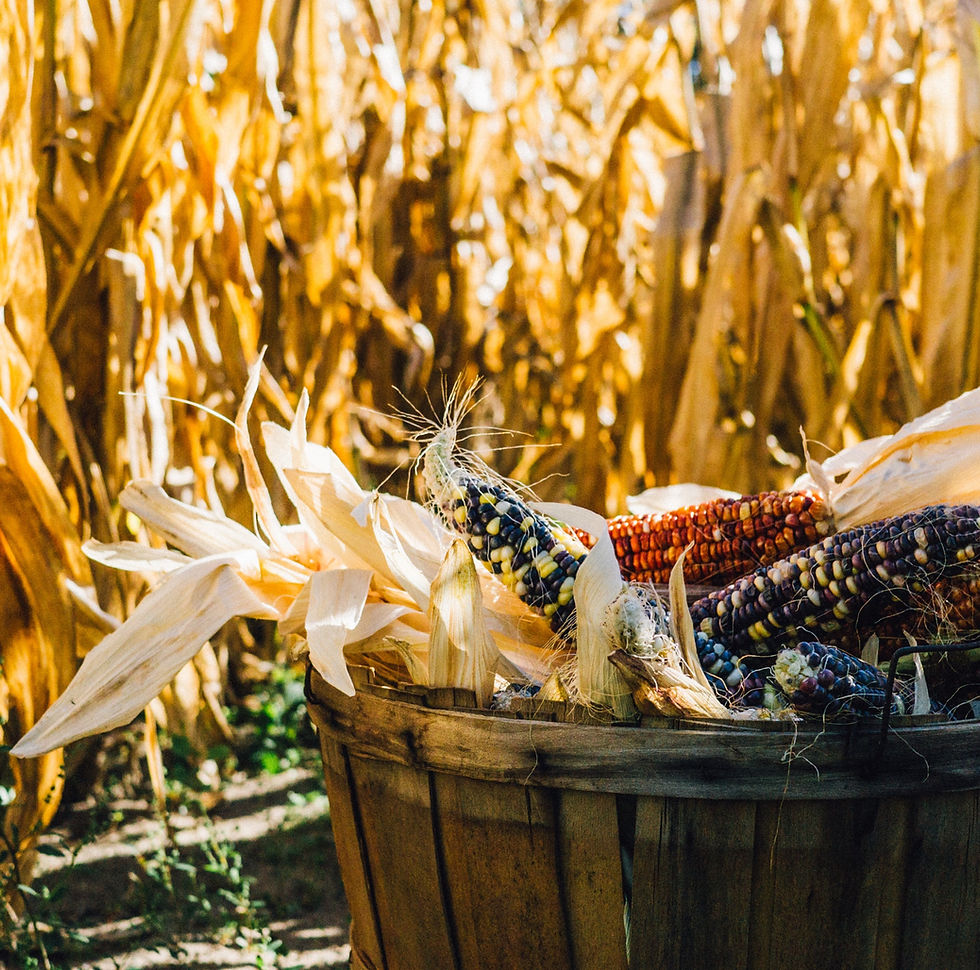
Celebrating thanksgiving and giving thanks are practices that reach way back into the foundational stories of our tradition. Now, by tradition, I’m not talking this morning aboutAmerican Thanksgiving traditions. I’m not talking about that particularly American myth of pilgrims and indigenous peoples. That’s a myth that we should leave behind.[1] It doesn’t honestly represent the history of colonization – of white colonial people and indigenous peoples. It gives a smiling face to all manner of atrocity and wrong.
No, I’m talking about the traditions of our Scriptures – and particularly traditions we find in the Hebrew Scriptures. In this morning’s Scriptures, we find ancient, still-living traditions of Thanksgiving celebration – a day set aside to give thanks – every year – and, in the Psalm we read together, we find a regular practice of giving thanks – every week, every day. All the time.
Give thanks to God for God is good.
God’s steadfast love endures forever.
In the Leviticus text this morning, we find God’s command to celebrate Thanksgiving.[2] That’s right. It’s a command. We think of Leviticus as being an ancient tribal rule-book: Do this. Don’t do that. And there is that. But at its heart, Leviticus is about living in healthy relationship with each other and with God. It’s about what is sacred – what ought to be set apart so that humans can learn what it is to live life with God.
And so Leviticus offers its ancient tribal rules: Do this. Don’t do that. And, in the midst of all that, God commands three holidays – three feasts – three Festivals. Every year do this. Every year set apart some time – make some time holy – to feast and to give thanks.[3]There’s Passover: Every year, without fail, remember and celebrate how God brought us up out of slavery and into freedom. Our Psalm this morning tells that story. Then, there’s the Feast of First Fruits (or the Feast of Weeks), celebrated in late spring, as the first of the crops come in. (It lines up with what we call Pentecost.)
And then – in this morning’s text – there is the Feast of Booths (temporary structures, huts) or Sukkot (the Hebrew word for Booths). It’s also known as the Feast of the Ingathering. Sukkot is the Hebrew harvest festival.[4] When the crops are in, after all that work is done – God gives an explicit command to rejoice and give thanks.
The central tradition of festival of Sukkot, to this day, is for each family to build a booth – usually a three-sided structure – with branches for a roof – branches gathered in the harvest.[5] It’s a reminder both of the huts they might have set up in the fields as they harvested – and also a reminder of the tents their ancestors inhabited in their 40 years of wilderness wandering.[6]
You remember: God led the people out of slavery in Egypt – into the broad expanse of wilderness, where they struggled and lived for 40 years. As they sojourned together, they lived in tents in the desert, a hard life. And God provided – manna in the morning, water from the rock – God accompanied them and sustained them – everywhere, all the time – for 40 years in the desert. And so, each year, when the harvest is in – set aside some time, rest, feast, remember, and give thanks.
Now, giving thanks at harvest is not unique to the Hebrew people. Cultures around the world and across the generations have given thanks at the harvest.[7] In recent centuries, there are national Thanksgiving traditions – American Thanksgiving, Canadian Thanksgiving. In the UK, the traditions are even more clearly linked to the bringing in of the harvest – reaching back to Briton traditions called Lammas. In Korea, there’s Chuseok – a harvest festival around the full moon. In southeast Asia, there’s Pongal, celebration of the rice harvest; and in Ghana, there’s thanksgiving for the harvest of yams. Celebrating harvest and giving thanks are an experience where around the world and over time religions and traditions converge.
What feels different – distinct – about Sukkot isn’t the harvest part – but this booth part. Celebrate harvest – and – celebrate your years in the desert. When the crops come in, enjoy the bounty, rejoice. Take two days off – a double sabbath – do no work. Feast and give thanks for the abundance that surrounds you and fills you. And, build booths – live in booths like your ancestors did in the desert. Celebrate the harvest and remember your wilderness wandering. Give thanks to God for God’s presence and God’s provision and God’s love – in all of that. Give thanks to God – in good times and not so good.
The gift of these Scriptures is the command – the invitation – to build giving thanks into the regular rhythm of our lives – to weave into the warp and weft of life a practice of gratitude – to allow ourselves time – regular time – to experience, enjoy, remember – God’s goodness – everywhere, all the time – and to give thanks.
Give thanks to God for God is good,
God’s steadfast love endures forever –
in good times and not so good.
Embracing a regular practice of gratitude isn’t just a place where religions and traditions converge – it’s also a place where religion and science converge. Over the past couple decades, researchers have conducted studies that again and again have shown connections between well-being, physical health, and gratitude.[8] Now, I had heard about these studies – from Oprah and from the mindfulness teachers I follow – but I hadn’t appreciated the depth and breadth of these studies. In these studies, researchers have found that people who were grateful: slept better; were less depressed and tired; were more confident and self-aware; had decreased instances of anxiety and panic attacks; and had lower risk of inflammation, to name a few.[9] One of the leading researchers in this area has summarized “gratitude benefits as [including] increased self-esteem, enhanced willpower, stronger relationships, deeper spirituality, and boosted creativity.”[10] Wow.
Now, I’m not touting gratitude as a panacea – as a quick fix to all that ails us. This is just to say that science is confirming what religious traditions have long known: A regular practice of gratitude – thanksgiving – is good for us – and good for the world. It connects us to the goodness in the world, and to God’s goodness.
It's ancient wisdom that we are living today. In our own traditions here, we regularly give thanks together. Today, we are setting aside a whole worship service for thanksgiving. And in every worship service we give thanks. Since COVID began, we’ve built Prayers of Thanksgiving into our time of offering; we give thanks to God in our response to the Assurance of Grace – and in our music. Our sacrament of communion is also known as the Eucharist – which means Thanksgiving. Part of communion is giving thanks in an embodied way for the real presence of Christ in the midst of us. And this Thursday, we’ll join our nation in giving thanks.
Giving thanks is something we do together. Regularly. And it is something that we can weave into the regular flow of our days. You could Google and find books and books on gratitude practices. I thought I’d just offer up three practices. And in the universe of spiritual practice, these are about as easy and refreshing as they come.
First, there’s the simple practice of setting aside a minute or two each day for daily gratitude. Back at the beginning of the year – New Year’s Resolution time – I did a good bit of reading on how to build good habits. One of the techniques researchers suggest is linking the new thing you want to do to something you are already doing every day. You brush your teeth every morning; you want to add a prayer of gratitude to your day; say a word of thanks when you brush your teeth. Link habits.
The most obvious opportunities for linking gratitude are probably waking up and going to bed. When you rise in the morning, name one thing for which you are grateful. It could be: “God, thank you for giving me another day.” Or, at night, as you go to bed, reflect back on the day – and name the experiences for which you are grateful. Or, there’s always mealtime. We’re almost hard-wired for that from childhood – to say grace at mealtime. Pick that practice up again. Right before a meal, in that moment when the meal is ready – and you sit down and settle in – take a deep breath – and give thanks. Waking – eating – sleeping – we are already doing those things – they frame our day – why not add a word of thanks to something we are already doing.
A second practice is writing your gratitude down – keeping a gratitude journal. I bet you’ve heard of that idea. The benefit of writing gratitude down is that you can see patterns over time – you effectively write a book of blessings.
And then a third practice: Say “thank you.” Every chance you get. Thank you. Whether it’s a spoken thank you, or a thank you note. Say, “Thank you.” This is something I learned from Janie Spahr – everywhere I’ve traveled with her – she packs a thank you gift. And I’ve traveled with Janie in good times and not so good – she’s all about, “And now, it’s time to say thank you.”
Now, I should say a couple things. Don’t beat yourself up about these practices. Gratitude is a blessing not a chore. If you set an intention to offer daily gratitude, and you miss three days – that just means when you settle in next time, you’ll have three days of things to be thankful for.
And, even more importantly, I should clarify what I’m not saying. I am not saying that we should force gratitude when we don’t feel it, or that we are or should be thankful for things that are bad– for things that hurt or for suffering. I’m not pointing us to gratitude as a way of pretending that bad things aren’t really bad. I hope we know each other well enough that you know how important I think it is to say that bad things are just plain bad. Our hurt hurts. Naming our hurt, and seeing the hurt of others, is an essential step toward healing.
No – a practice of gratitude isn’t about denial or pretending – it’s more about the “both/and” of life – honoring our experience of both the good and the bad – but not letting the bad overwhelm us – not letting it be the only story we tell. It’s about keeping our hearts open – to experience the good – to name the good – God’s love and goodness – always with us – in the midst of harvest and feast – and also in our desert places.
Give thanks to God for God is good.
God’s steadfast love endures forever.
God is near.
In good times and not so good.
Gratitude is after all a response. That’s really the heart of it. Gratitude is our response to... grace. Gratitude is what comes next, right after... “Grace abounds!” God overflows with grace – from the first moment of creation – all the way till now – all God’s good gifts – life, and breath, and love, and every bit of creation around us. Grace abounds – we receive the gift – and what we feel in our bones – that’s gratitude. Karl Barth put it like this: “Grace and gratitude belong together like heaven and earth. Grace evokes gratitude like the voice, an echo. Gratitude follows grace like thunder, lightning.”[11]
Gratitude is an emotion – something we experience and feel. And, lived out, it also becomes an action – an ethos – an ethic – a way of life – a life of gratitude. Now, there’s one way of thinking about grace and gratitude that’s kind of like that call and response we did in the Psalm. God sends grace, we speak back gratitude. A back and forth between us and God.
This week I ran across an image even more powerful that – it’s in Diana Butler Bass’s excellent book, Grateful. She envisions it like a circle.[12] Grace is like a pebble dropped in a pond. Gratitude is the set of ripples that radiate outward, spreading that gift that grace, further and further – each gift of kindness, a drop of grace, radiating out, blessing the next person, and the next – blessing the whole world – in this circle of grace and gratitude and grace.
In the stories of our tradition, the people were in slavery, and God brought them up and out into freedom. And God said, remember and give thanks.
They wandered in the desert – a hard life – and along the way – God nourished them with water from the rock, and manna in the morning. And God said, remember and give thanks.
And when we were most in need, God came to us in Jesus Christ – full of healing, and wisdom, and life – saving us from everything that does us harm – the Word became flesh and dwelt in us, full of grace and truth. And we remember and give thanks.
Give thanks to God for God is good.
God’s steadfast love endures forever.
In saying that,
in living that out,
we help to make it so.
© 2022 Scott Clark
[1] See https://www.smithsonianmag.com/history/thanksgiving-myth-and-what-we-should-be-teaching-kids-180973655/ [2] For general background on this text, see Walter C. Kaiser, Jr., “Leviticus,” New Interpreters’ Bible Commentary, vol. i (Nashville, TN: Abingdon Press, 1994), pp. 1159-61. [3] Walter Brueggemann explains that the Festivals were intended to invoke gratitude to remind the people “that their community was grounded in generosity and gratitude, completely dependent on the gifts of a good God.” See Diana Butler Bass, Grateful (New York: HarperOne, 2017), pp. 112-13. [4] For more on the festival of Sukkot see Bruce Chilton,“Sukkot,” The New Interpreter’s Dictionary of the Bible, vol. 1 (Nashville, TN: Abingdon Press, 2006) https://www.reformjudaism.org/jewish-holidays/sukkot ; https://www.chabad.org/library/article_cdo/aid/4784/jewish/What-Is-Sukkot.htm ; https://www.learnreligions.com/feast-of-tabernacles-700181 [5] See id. [6] See Kaiser, pp. 1159-61. [7] See https://www.nationalgeographic.com/travel/article/harvest-festivals ; https://www.onegreenplanet.org/uncategorized/ten-amazing-harvest-festivals-from-around-the-world/ ; [8] For an excellent and accessible summary of these health benefits, see Diana Butler Bass, Grateful (New York: HarperOne, 2017), pp. 28-29; see also https://www.health.harvard.edu/healthbeat/giving-thanks-can-make-you-happier [9] Id. [10] Id., p. 29. [11] Karl Barth, quoted in Diana Butler Bass, p.3. [12] See Diana Butler Bass, pp. 20, 175-78.
Photo credit: Arron Burden, used with permission via Unsplash


Comments